The Fear Every Parent Feels Before Reporting
You already know the bullying is happening. You have seen the signs at home. Your child has told you — or shown you — that school has become a place they dread.
And now you are trying to decide whether to report it. And underneath that decision is a fear that almost every parent in this situation carries: What if reporting it makes things worse?
That fear is not irrational. It comes from a real place — from stories parents have heard, from the worry that bringing attention to the situation will turn a target on your child's back. I understand why parents hesitate.
But here is what I want you to know: the fear of reporting should not stop you from reporting. What matters is what you ask for the moment you do.
What I See Parents Get Wrong About Reporting
The most common mistake I see parents make is treating the report itself as the protection. They file the complaint, they send the email, they tell the principal — and then they wait.
But the report is not the protection. The documented safety plan that follows it is.
A report without a safety plan is a record without accountability. The school has been notified — but nothing has been specified about who is responsible for protecting your child, when, where, and how. Without those specifics in writing, the situation can continue while the school takes its time figuring out what to do.
The moment you report, you need to ask for something specific in return.
What to Ask for the Moment You Report
The immediate next step after making a bullying report is to ask the school district for a documented safety plan. Not a verbal commitment. Not a general assurance. A written document that clearly outlines who is protecting your child and how.
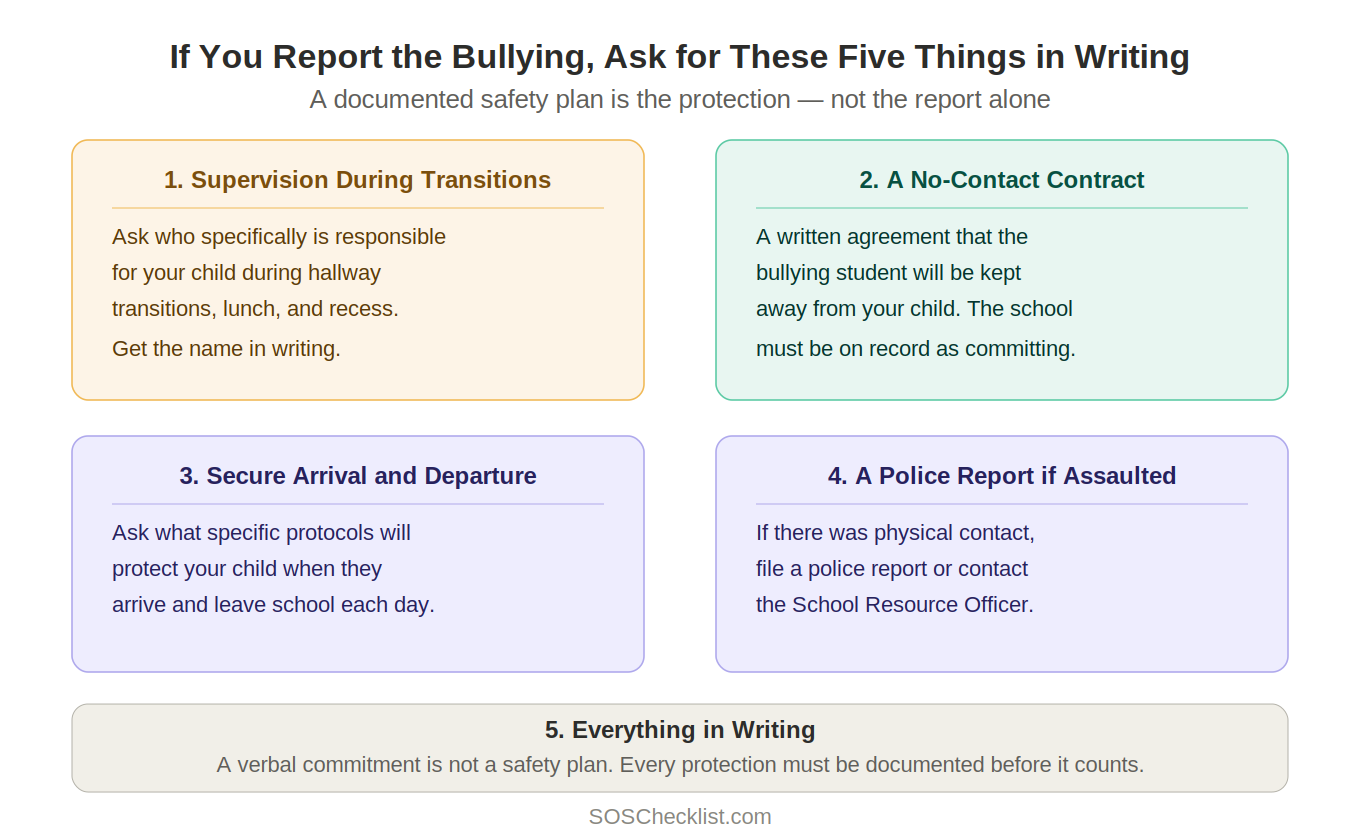
That safety plan should address five specific areas:
Supervision during class transitions — who is responsible for your child in the hallways, and by name
A no-contact contract — a written agreement that the bullying student will be kept away from your child
Secure arrival and departure — what protocols are in place at the start and end of each school day
Protected lunch and recess — unstructured time is where most bullying happens; the plan must address it specifically
Everything in writing — a verbal commitment is not a safety plan; it must be documented before it counts
When you ask for these five things in writing, you are changing the nature of the conversation. You are no longer just reporting a problem — you are requesting an accountable response.
If You Report the Bullying, Ask for These Five Things in Writing
What to Do If There Was a Physical Assault
If your child has been physically assaulted — pushed, hit, choked, or harmed in any way — the steps I want parents to take go beyond the school report.
File a police report, or contact the School Resource Officer at the school. Do this without hesitation. I know it can feel like an escalation, but physical harm is not a school discipline matter alone — it is a matter of record, and that record matters.
Take your child to urgent care for an outside medical report. Take photographs of any visible injuries. Document whether your child is too afraid to return to school. And if the trauma is significant, get your entire family into therapy to help process what happened.
These are not overreactions. They are the documentation that protects your child — and your ability to advocate for them — going forward.
What Parents Often Misunderstand About Retaliation
Sometimes, after a report is made, things do get harder before they get better. The bullying student finds out a complaint was filed. Social dynamics shift. Your child may face increased pressure or isolation.
This is painful — but it is also information. If the bullying escalates after a report, that escalation is itself a reportable incident. Document it. Report it. Add it to the written record you are building.
Retaliation after a report does not mean you were wrong to report. It means the school now has an additional documented responsibility to address. A school that fails to respond to retaliation after a bullying report has compounded its accountability — not reduced yours.
Mistakes I Would Avoid
1. Waiting to report because you are afraid of retaliation.
The fear of making things worse is real, but silence does not protect your child. It removes the school's documented obligation to act. Report, and ask for a safety plan immediately.
2. Accepting a verbal safety commitment from the school.
"We will keep an eye on things" is not a safety plan. Ask what is being documented, who is responsible, and what specifically will happen during transitions, lunch, arrival, and departure.
3. Reporting without following up in writing.
Whether you reported by phone, in person, or by email, follow up in writing to confirm what was reported, when, and what response you were given. That written record matters.
4. Not filing a police report after a physical assault.
A school incident report and a police report are not the same thing. If your child was physically harmed, file both. The police report creates a formal record outside the school system.
5. Assuming the safety plan will be enforced without follow-up.
Even if the school creates a written safety plan, check in regularly. Ask specifically whether the plan is being implemented. Document your check-ins. If something is not being followed, report that too.
Questions to Ask Before and After You Report
Have I submitted my report in writing, with the date, my child's name, and a clear description of what happened?
Have I asked for a documented safety plan — not just a verbal response?
Does the safety plan name a specific staff member responsible for protecting my child?
Does it address transitions, lunch, recess, arrival, and departure?
If there was a physical assault, have I filed a police report or contacted the School Resource Officer?
Am I documenting any changes in the bullying behavior after I reported?
When Outside Help May Be Appropriate
If you have reported the bullying and the school has not provided a documented safety plan, or if the bullying has escalated after a report without a meaningful school response, it may be time to consider additional support.
A school safety bullying consultant can help you understand what a safety plan should contain, identify whether the school's response meets a reasonable standard, and prepare you for the next escalation step.
If the situation involves a physical assault or ongoing physical safety concerns, consulting with a qualified attorney familiar with education law in your state — in addition to filing a police report — may be appropriate.
If your child is experiencing fear, trauma, or significant emotional distress as a result of the bullying, connecting with a qualified mental health professional is an important parallel step.
And if your child is ever in immediate danger, contact emergency services right away.
Take the Safety Over Silence Checklist
Before your next communication with the school — whether you have already reported or are preparing to — take the Safety Over Silence Checklist at https://soschecklist.net. It can help you identify what you have documented, what safety elements may be missing from the school's response, and what your next step should be.
Disclaimer
The Student Readiness Checklist and Safety Over Silence content are educational resources only. They do not provide legal, medical, mental health, therapeutic, or crisis advice; determine whether a school or individual violated the law; guarantee a particular outcome; or create an attorney-client, therapist-client, or other licensed professional relationship. Laws, school policies, and procedures vary by jurisdiction and circumstance. Consult an appropriately qualified professional regarding your specific situation. If a child is in immediate danger, contact emergency services or the appropriate local authority. If a child is experiencing a mental health crisis or expressing thoughts of self-harm, call or text 988 in the United States or seek immediate qualified help.
Frequently Asked Questions
Will the bullying get worse if I report it to the school?
It sometimes does, temporarily. But fear of retaliation should not stop a parent from reporting. The more important question is what you ask for the moment you report. A documented safety plan — with specific protections in writing — changes the school's accountability. If bullying escalates after a report, that escalation is itself a new incident to document and report.
What should I ask for immediately after reporting bullying to the school?
Ask for a documented safety plan in writing. That plan should identify who is specifically responsible for supervising your child during transitions, include a no-contact contract with the bullying student, and address arrival, departure, lunch, and recess. A verbal commitment is not a safety plan.
Should I file a police report if my child was physically assaulted at school?
Yes. If your child was physically harmed, filing a police report or contacting the School Resource Officer creates a formal record outside the school system. A school incident report and a police report are separate documents — both matter. Take your child to urgent care for an outside medical report and photograph any injuries.
What is a no-contact contract and how do I ask for one?
A no-contact contract is a written school agreement that the student who has been bullying your child will be kept away from them. It creates a documented commitment on the school's part. Ask for it specifically and in writing as part of any safety plan discussion after you report. It is a direct point to all students involved and if violated (wilful defiance) it will means further disciplinary action will be enforced.
What do I do if the bullying gets worse after I report it?
Document the escalation immediately — dates, descriptions, who was involved. Report it as a new incident, referencing the original report. If the school does not respond appropriately to retaliation after a complaint, that failure adds to the school's documented responsibility.
How can the Safety Over Silence Checklist help after I report bullying?
The Safety Over Silence Checklist at https://soschecklist.net helps parents identify whether the school's response includes the documented safety elements your child needs — supervision, no-contact contract, safe transitions, and more. It also helps you spot gaps before they become problems.
Is this article legal advice?
No. This article is educational content only. It does not constitute legal, medical, mental health, or crisis advice, and does not create any professional relationship. Laws, school policies, and procedures vary by jurisdiction. Consult a qualified attorney or other appropriate licensed professional for guidance specific to your situation.
When should I consider working with a school safety consultant?
Whenever you feel the school isn’t respecting you or If the school has not provided a documented safety plan after a bullying report, if the bullying has escalated without a meaningful response, or if you are unsure whether the school's actions meet a reasonable standard, a school safety consultant may help you organize your documentation and prepare your next step.
References
StopBullying.gov — How to Report Bullying: https://www.stopbullying.gov/resources/get-help/find-a-local-organization
StopBullying.gov — Federal Laws on Bullying: https://www.stopbullying.gov/resources/laws
U.S. Department of Education — School Safety: https://www.ed.gov/school-safety
California Department of Education — Bullying Prevention: https://www.cde.ca.gov/ls/ss/se/bullyingprev.asp
National Association of School Resource Officers (NASRO): https://www.nasro.org (URL should be verified before publication)