
The Impulse Almost Every Parent Has
Your child has been hurt — emotionally, socially, sometimes physically — by another student. And somewhere in the middle of your anger and worry, a thought forms: maybe if I just talked to that other parent, parent to parent, this could get resolved.
It is a completely understandable impulse. You are a parent. You assume the other parent would want to know, would want to fix it, would react the way you would if the roles were reversed.
But I want to be direct with you about this, because it matters: under no circumstances should a parent contact the other parent directly.
Why This Conversation Almost Always Goes Wrong
This is never appropriate, and the reason is simple — the situation can easily escalate and go sideways.
You do not know how that other parent will receive the conversation. They may become defensive. They may dismiss your concerns entirely. They may turn the conversation around and blame your child. In the worst cases, the conversation becomes confrontational in a way that creates an entirely new problem — one that has nothing to do with resolving the bullying and everything to do with conflict between two adults.
And once that happens, you cannot undo it. There is no walking it back to the calm, documented approach you would have had if you had gone through the school instead.
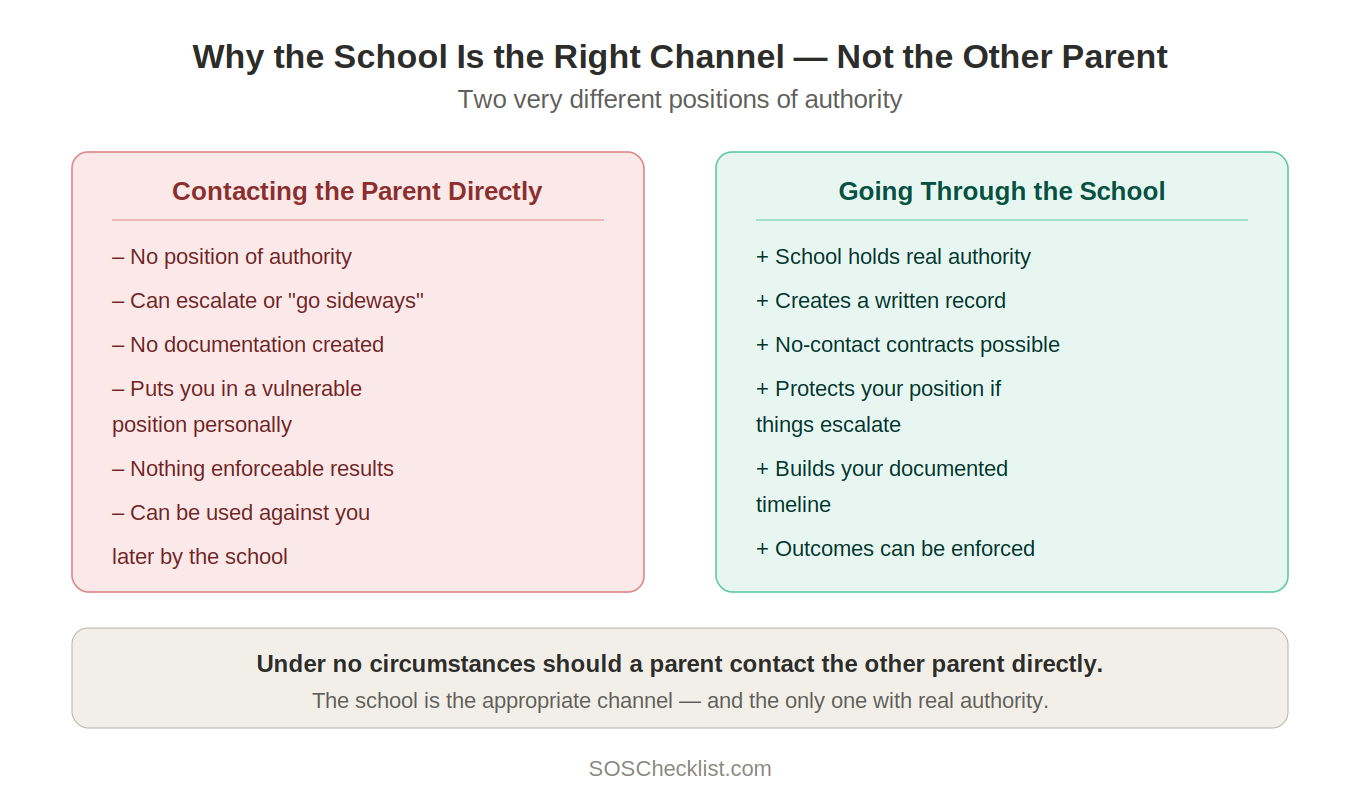
Why the School Is the Right Channel — Not the Other Parent
You Do Not Have the Authority the School Has
Here is the core issue: the victim's parent does not have the position of authority over the other parent or student that the school district holds.
When you go through the school, you are accessing a structure that has actual tools — investigation processes, no-contact contracts, disciplinary consequences, documented accountability. When you go directly to the other parent, you have none of that. You are simply one parent talking to another parent, with no authority to require anything and no documentation created by the conversation.
Even if the other parent is receptive and well-intentioned, nothing about that conversation is enforceable. There is no written record the school can act on. There is no formal commitment that holds up if the behavior continues.
And if the conversation goes poorly, you have put yourself in a vulnerable position — personally, and potentially in terms of how the situation is later perceived by the school.
What I Want Parents to Do Instead
Every instinct you have to reach out to that other parent — channel it into your communication with the school instead.
Report the specific incidents in writing. Ask for a no-contact contract between the students. Ask the school to address the behavior through their formal process, which has actual consequences and documentation behind it. The school is positioned to require change in a way that a conversation between two parents simply cannot.
This is not about avoiding the issue. It is about pursuing it through the channel that can actually produce results — and that protects you and your family in the process.
Mistakes I Would Avoid
1. Reaching out to the other parent because it feels like the fastest path.
It may feel faster, but it is not more effective. It carries real risk and produces nothing enforceable, even when it goes well.
2. Confronting the other parent in person at pickup, drop-off, or a school event.
These encounters are unplanned, emotional, and witnessed by others — including children. They rarely go the way you hope, and they can create complications that distract from the actual issue.
3. Messaging the other parent through social media or a mutual contact.
Indirect contact still carries the same risks as direct contact, and it can be even harder to control how the message is received or shared further.
4. Assuming the other parent will respond the way you would.
You cannot predict how someone will react when told their child is being accused of bullying. Many parents become defensive rather than receptive, regardless of how calmly the concern is raised.
5. Letting frustration with the school's pace push you toward contacting the parent.
If the school is moving too slowly, the answer is to escalate within the school system — not to bypass it by going to the other family directly.
Questions to Ask Before You Act
Have I reported this specific incident to the school in writing?
Have I asked the school whether a no-contact agreement between the students is possible?
Am I tempted to contact the other parent out of frustration with how slowly the school is moving?
What would I want documented if this situation needed to be escalated later?
Is there a school staff member I can loop in if I am at a school event where I might encounter the other parent?
When Outside Help May Be Appropriate
If you feel strongly that the other family needs to be addressed and the school has not taken meaningful action, that is the moment to escalate within the school system or consult a professional — not to go around the process.
A school safety or bullying consultant can help you understand what to request from the school, including a no-contact contract, and how to document the situation effectively.
If there has been any threat, harassment, or behavior involving the other family that concerns you for your safety or your child's safety, consulting with a qualified attorney or, if appropriate, law enforcement, is the right path — not a direct, unplanned conversation.
If your child is experiencing significant emotional distress related to the bullying, a qualified mental health professional can provide support that runs alongside your advocacy efforts.
Take the Safety Over Silence Checklist
Before you respond to this situation in any direction, take the Safety Over Silence Checklist at SOSChecklist.net. It can help you organize what has happened, identify the right channel for your next step, and prepare for a documented conversation with the school instead.
Disclaimer
The Student Readiness Checklist and Safety Over Silence content are educational resources only. They do not provide legal, medical, mental health, therapeutic, or crisis advice; determine whether a school or individual violated the law; guarantee a particular outcome; or create an attorney-client, therapist-client, or other licensed professional relationship. Laws, school policies, and procedures vary by jurisdiction and circumstance. Consult an appropriately qualified professional regarding your specific situation. If a child is in immediate danger, contact emergency services or the appropriate local authority. If a child is experiencing a mental health crisis or expressing thoughts of self-harm, call or text 988 in the United States or seek immediate qualified help.
Frequently Asked Questions
Should I contact the bully's parents directly?
No. Under no circumstances should a parent contact the other parent directly. This kind of conversation can easily escalate and go in an unexpected direction, and as the victim's parent, you do not hold the position of authority over the other parent or student that the school district holds. The school is the appropriate channel for addressing the bullying.
Why is contacting the other parent risky?
You cannot control how the other parent will respond. They may become defensive, dismiss the concern, or the conversation may become confrontational. Unlike going through the school, a direct conversation creates no documentation and no enforceable outcome — even in the best case.
What should I do instead of contacting the other parent?
Report the specific incidents to the school in writing, and ask whether a no-contact contract between the students can be put in place. The school has formal processes, documentation, and consequences available that a parent-to-parent conversation does not.
What if I run into the other parent at a school event?
Avoid initiating a conversation about the bullying in that setting. Unplanned, emotional encounters — especially in front of others or children — rarely go well. If you have concerns about an encounter, consider looping in a school staff member ahead of time.
What is a no-contact contract and how do I request one?
A no-contact contract is a written agreement, facilitated by the school, that the student involved in bullying will be kept away from your child. Ask your school directly whether this is something they can put in place as part of their response to your written report.
How can the Safety Over Silence Checklist help with this decision?
The Safety Over Silence Checklist at SOSChecklist.net helps parents organize what has happened and identify the right channel — typically the school — for addressing a bullying concern, rather than approaching the other family directly.
Is this article legal advice?
No. This article is educational content only. It does not constitute legal, medical, mental health, or crisis advice, and does not create any professional relationship. For guidance specific to your situation, consult a qualified attorney or other appropriate licensed professional.
When should I involve law enforcement instead of the school?
If there has been a threat, harassment, or any behavior involving the other family that raises safety concerns, consulting with law enforcement or a qualified attorney is appropriate, rather than a direct, unplanned conversation with the other parent.
References
StopBullying.gov — How to Report Bullying: https://www.stopbullying.gov/resources/get-help/find-a-local-organization
StopBullying.gov — Talking to Kids About Bullying: https://www.stopbullying.gov/resources/parents
U.S. Department of Education — School Safety: https://www.ed.gov/school-safety
California Department of Education — Bullying Prevention: https://www.cde.ca.gov/ls/ss/se/bullyingprev.asp
Oklahoma State Department of Education — Safe Schools: https://sde.ok.gov/safe-schools (URL should be verified before publication)