"We Didn't Know" Is a Common School Response
You report the bullying, and the school's response is some version of: we were not aware of this. We had no prior knowledge. This is the first we are hearing about it.
It is one of the most frustrating things a parent can hear, especially when your child has told you that staff already knew, that other students had reported the same behavior, or that this was clearly an established pattern before your formal complaint ever landed on anyone's desk.
So the question becomes: how do you actually prove the school knew?
What Prior Knowledge Really Means
Here is something important that many parents do not realize: prior knowledge can be established in more ways than a formal written complaint.
If your child shares that the student bullying them "messes with everyone," that single statement can demonstrate the school was already aware of the student's harassing behavior. It suggests a pattern — one that staff would reasonably have encountered or been told about before your child became a target.
This kind of detail, gathered directly from your child, can become an important piece of your documentation. It is not proof on its own, but it points toward a broader pattern the school may already have had some awareness of.
Prior Notice Does Not Require the Principal
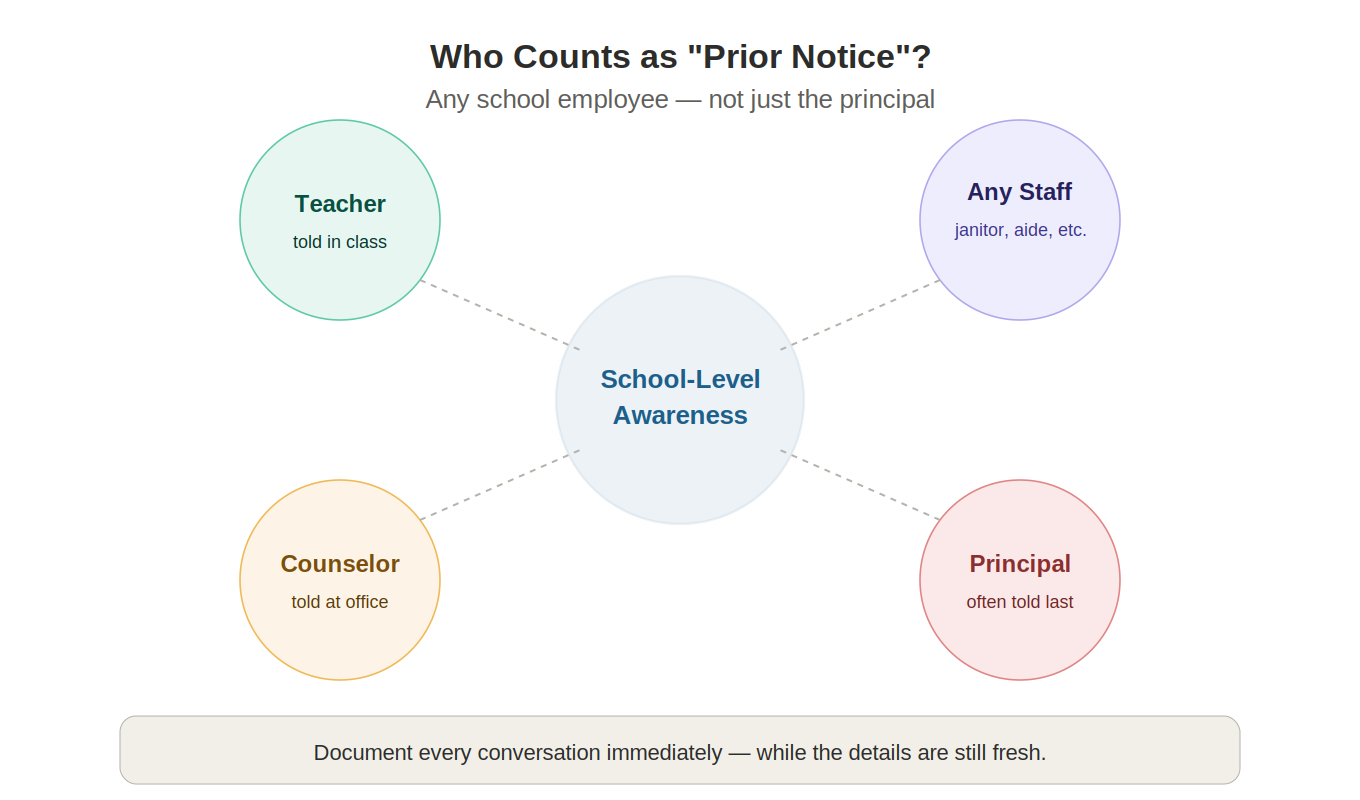
This is the detail I want every parent to understand clearly: prior notice counts as notifying anyone employed at the school site — a teacher, a janitor, a counselor, an aide, or the principal. It does not have to go through the principal's office to count.
Why does this matter so much? Because not all information reaches the principal directly. A teacher may know about ongoing harassment in their classroom for weeks before it ever gets formally escalated. A janitor may witness something in a hallway. A counselor may have heard about it from another student entirely.
If any of those staff members were told — by your child, by you, or by another parent — that is prior notice. The school's awareness does not begin and end with the principal's inbox.
Who Counts as "Prior Notice"?
Why Documentation Has to Happen Immediately
Knowing that any staff member's awareness counts is only useful if you can actually demonstrate it happened. And that is where most parents lose ground — not because the notice did not happen, but because it was never written down.
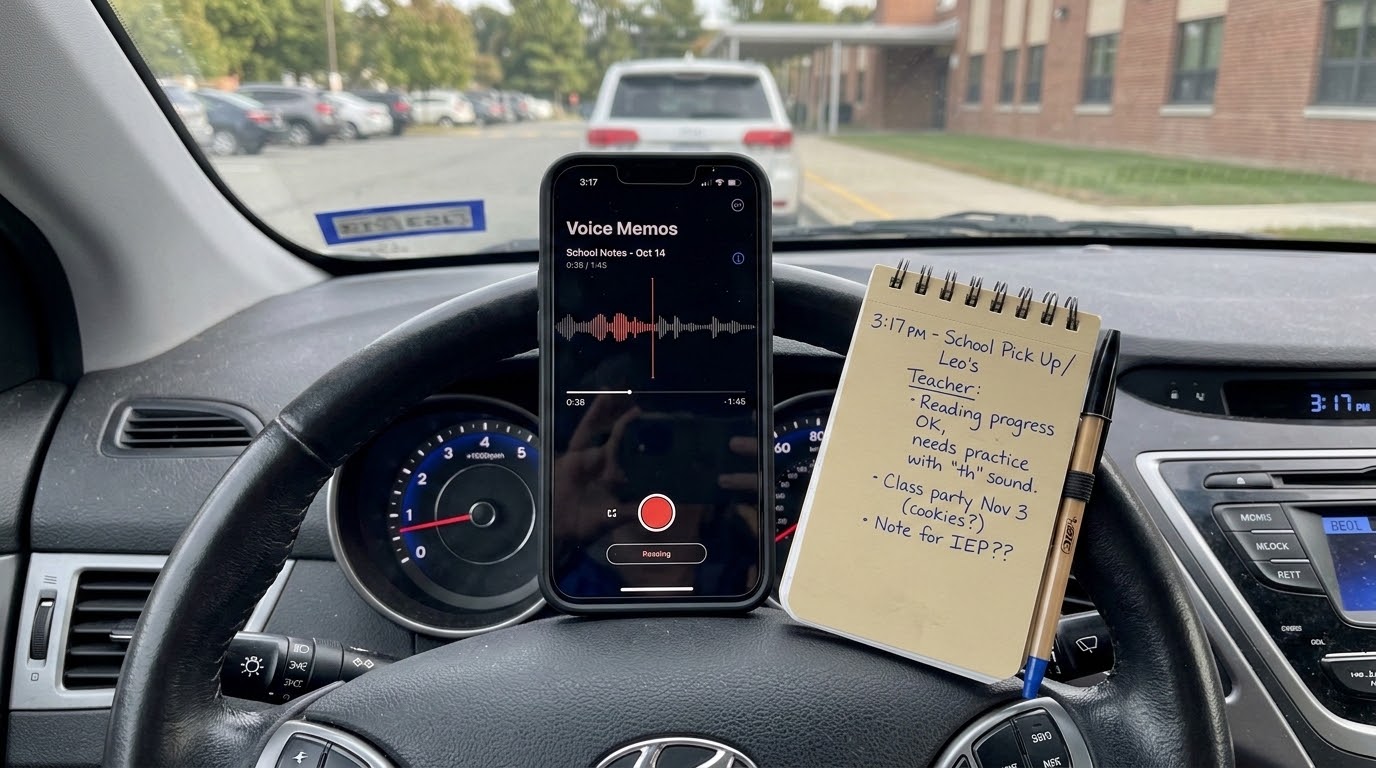
This is why I recommend documenting all conversations with teachers and staff immediately. Use the speech-to-text function on your phone, or a voice recorder, right as you are walking out of the building — while the details are still fresh in your mind.
Capture who you spoke with, what their role is, what was said, and the date and approximate time. Then, as soon as you can, turn that into a written note or a follow-up email. The goal is to create a timestamped, contemporaneous record something created close to the moment, not reconstructed weeks later from memory.
A conversation that happened but was never documented is, practically speaking, very difficult to use later. A conversation captured the same day, with specific details, becomes part of a real record.
Building the Pattern, Not Just the Incident
One of the most persuasive things you can show a school or anyone else evaluating the situation later is a pattern, not a single isolated event.
If your child mentions that the same student has bothered other kids, or that a staff member once said something like "we know about him," those details matter. They suggest the school's awareness predates your formal complaint. Write those details down too, with the date your child told you and as close to their own words as possible.
A pattern of awareness across multiple staff members, multiple conversations, and multiple points in time is far more powerful than a single complaint that the school can frame as the first they ever heard of it.
Mistakes I Would Avoid
1. Assuming only a formal complaint to the principal counts as notice.
Any school employee's awareness counts. Do not wait to escalate to the principal before you start documenting — start documenting the moment any staff member is informed.
2. Waiting to write things down.
Memory fades quickly, and details get reconstructed inaccurately over time. Document conversations the same day, ideally within minutes, using speech-to-text or a voice memo.
3. Treating your child's offhand comments as unimportant.
A statement like "he messes with everyone" can be meaningful evidence of a known pattern. Take note of these comments and the date your child made them.
4. Not noting the specific role of the staff member you spoke with.
"I told someone at the school" is far weaker than "I told Ms. [Name], my child's homeroom teacher, on [date]." Specificity matters.
5. Relying only on your own conversations.
If other parents have raised similar concerns about the same student, that strengthens the pattern. You cannot control what other families do, but if you become aware of related reports, document that you became aware of them and when.
Questions to Ask Yourself as You Build This Record
Has my child mentioned that the student bullying them has done this to others?
Have I spoken to any school staff member, teacher, counselor, aide, or otherwise about this situation, even informally?
Did I document that conversation immediately, including the date, the staff member's name and role, and what was discussed?
Am I capturing my child's own words as close to verbatim as possible when they share new details?
Do I have a written, timestamped record I could reference if the school later claims they had no prior knowledge?
When Outside Help May Be Appropriate
If the school continues to deny prior knowledge despite documented conversations with staff, or if you believe a pattern of awareness was not acted upon appropriately, consulting with a qualified attorney familiar with education law in your state may be appropriate.
A school safety or bullying consultant can help you organize scattered notes and conversations into a clear, chronological record that effectively demonstrates prior notice.
If your child is struggling emotionally with the ongoing situation, a qualified mental health professional can provide support that complements and does not replace your documentation efforts.
Take the Safety Over Silence Checklist
Before your next conversation with the school, take the Safety Over Silence Checklist at SOSCheclist.net. It can help you organize the conversations you have already had, identify what documentation may be missing, and prepare to demonstrate the school's prior knowledge clearly.
Disclaimer
The Student Readiness Checklist and Safety Over Silence content are educational resources only. They do not provide legal, medical, mental health, therapeutic, or crisis advice; determine whether a school or individual violated the law; guarantee a particular outcome; or create an attorney-client, therapist-client, or other licensed professional relationship. Laws, school policies, and procedures vary by jurisdiction and circumstance. Consult an appropriately qualified professional regarding your specific situation. If a child is in immediate danger, contact emergency services or the appropriate local authority. If a child is experiencing a mental health crisis or expressing thoughts of self-harm, call or text 988 in the United States or seek immediate qualified help.
Frequently Asked Questions
How do I prove the school had prior knowledge of the bullying?
Prior knowledge can be established by documenting that any school employee — a teacher, counselor, janitor, aide, or principal was informed about the bullying before your formal complaint. It can also be supported by details like your child mentioning that the bullying student "messes with everyone," which suggests a known pattern. Document every relevant conversation immediately, including names, roles, dates, and what was discussed.
Does prior notice have to go through the principal?
No. Prior notice counts as notifying anyone employed at the school site. Because not all information reaches the principal directly, a conversation with a teacher, counselor, or other staff member can establish that the school was aware of the situation.
How quickly should I document a conversation with school staff?
As immediately as possible ideally within minutes, while the details are still fresh. Jerry recommends using the speech-to-text function on your phone or a voice recorder right as you are walking out of the building, then turning that into a written note or follow-up email.
What if my child says the bullying student has done this to other kids?
That kind of statement can be meaningful. It suggests the school may already have been aware of a pattern of behavior before your child became a target. Write down what your child said, as close to their exact words as possible, along with the date.
What should I include when documenting a conversation with a teacher about bullying?
Include the staff member's name and role, the date and approximate time of the conversation, and a summary of what was discussed. Specific, timestamped details are far more useful later than a vague memory of "telling someone at the school."
How can the Safety Over Silence Checklist help me document prior knowledge?
The Safety Over Silence Checklist at SOSCheclist.net helps parents organize the conversations they have already had with school staff, identify documentation gaps, and prepare a clear record demonstrating the school's awareness of the situation.
Is this article legal advice?
No. This article is educational content only. It does not constitute legal, medical, mental health, or crisis advice, and does not create any professional relationship. For guidance specific to your situation, consult a qualified attorney or other appropriate licensed professional.
When should I consult an attorney about a school denying prior knowledge?
If you have documented conversations with school staff establishing prior notice and the school continues to deny awareness, or if you believe that awareness was not acted upon appropriately, consulting a qualified attorney familiar with education law in your state is an appropriate next step.
References
StopBullying.gov — How to Report Bullying: https://www.stopbullying.gov/resources/get-help/find-a-local-organization
U.S. Department of Education Office for Civil Rights — Harassment and Bullying Guidance: https://www2.ed.gov/about/offices/list/ocr/docs/dcl-factsheet-201410.pdf
StopBullying.gov — Federal Laws: https://www.stopbullying.gov/resources/laws
California Department of Education — Bullying Prevention: https://www.cde.ca.gov/ls/ss/se/bullyingprev.asp
Oklahoma State Department of Education — Safe Schools: https://sde.ok.gov/safe-schools (URL should be verified before publication)