The Question Behind the Clock
You filed the complaint. You did the hard part — you put it in writing, you sent it to the right person, and now you are watching the clock.
How long is too long? When does silence stop being "they're looking into it" and start being a problem you need to escalate?
This is one of the most practical questions parents ask, and it deserves a practical answer.
What a Normal Response Time Looks Like
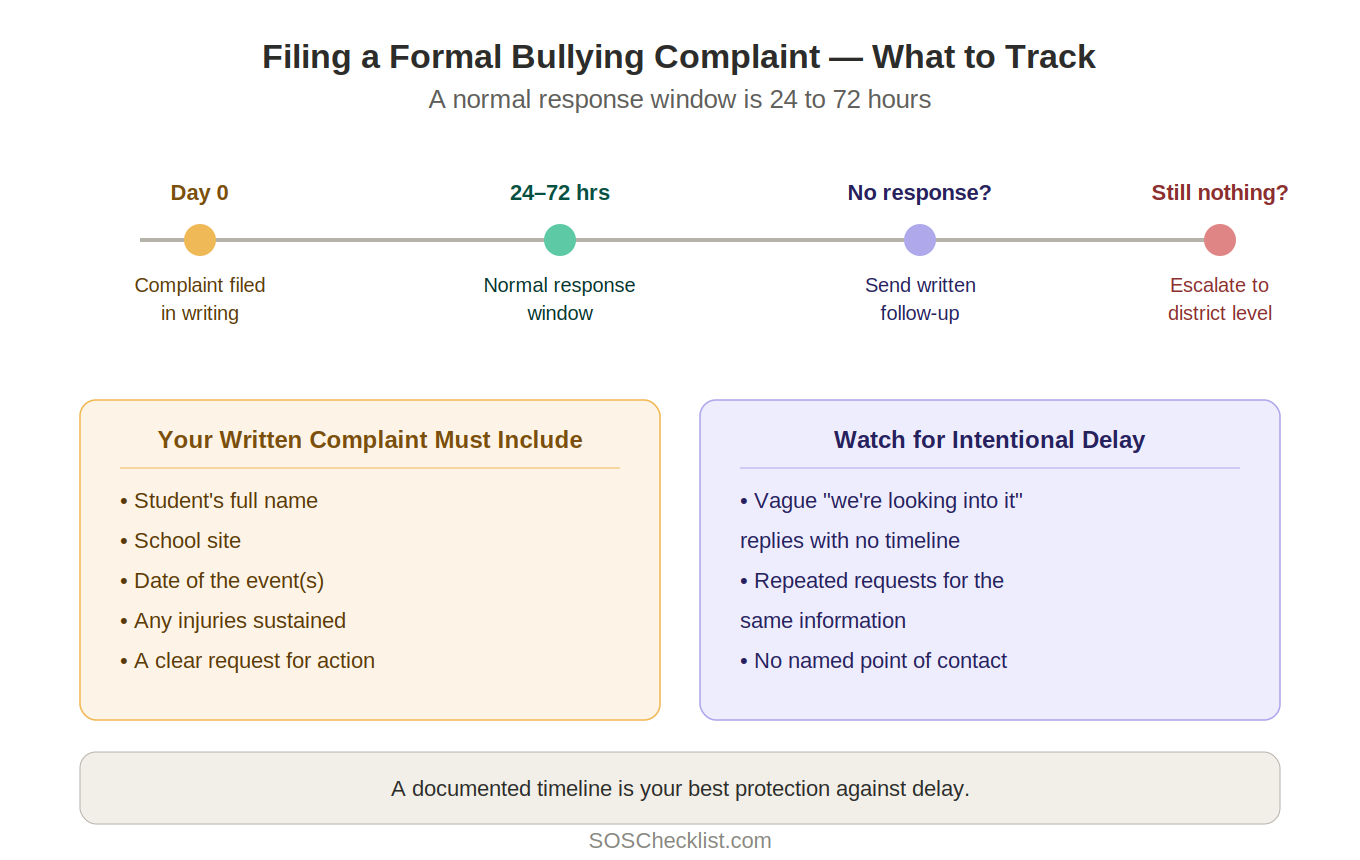
While response timeframes can vary by district and by the nature of the complaint, a normal response time should be within 24 to 72 hours.
That does not mean the entire investigation will be wrapped up in three days. It means you should hear something — an acknowledgment that your complaint was received, who is handling it, and what the next step will be. Silence that extends well beyond 72 hours, with no acknowledgment at all, is a signal that something needs to change in your approach.
Why the Written Complaint Matters So Much
Before we talk about tracking the response, I want to be clear about what starts the clock in the first place: a written complaint.
It is crucial that parents submit the complaint in writing — not just a phone call, not just a conversation at pickup. Your written complaint should include the student's name, the school site, the date of the event, and any injuries sustained. This establishes what is called a documented notice of harm.
That documented notice is what creates accountability. It is the timestamp that everything else gets measured against — including how quickly, or how slowly, the school responds.
Filing a Formal Bullying Complaint — What to Track
Why Schools Sometimes Delay — And What It Means
I want to be honest with parents about something important: school districts may intentionally delay investigations to buy time to get their story straight.
I know that is a hard thing to hear. But in my experience, school districts will lie to parents every day — not always maliciously, but often defensively. A delay can be a way of giving themselves time to gather their own version of events, talk to staff, and prepare a response that protects the district rather than addresses your child's safety as quickly as possible.
Understanding this does not mean assuming bad faith from every school. It means staying alert to the signs of intentional delay, and not mistaking silence for diligence.
Signs the Delay May Be Intentional
Vague responses like "we're looking into it" with no specific timeline or next step
Repeated requests for information you have already provided in writing
No named point of contact who is responsible for your complaint
Responses that focus on process rather than your child's immediate safety
A pattern of communication that slows down right when you ask for specifics
If you are seeing these signs, it is time to follow up in writing and, if necessary, escalate beyond the original recipient of your complaint.
What to Do If the Response Window Has Passed
If 72 hours have passed with no acknowledgment, send a brief, factual, written follow-up. Reference the date of your original complaint, restate what you submitted, and ask directly: what is the status of this investigation, and who is the point of contact?
If that follow-up also goes unanswered, it is time to escalate. Contact the superintendent's office, the director of pupil safety, or the assistant superintendent of student services, and include your documented timeline — the original complaint date, your follow-up date, and the lack of response. An organized, documented escalation is far more effective than a frustrated phone call.
Mistakes I Would Avoid
1. Filing the complaint verbally instead of in writing.
A verbal complaint does not establish a clear, timestamped notice of harm. Always submit your complaint in writing, and keep a copy.
2. Leaving out key details in the original complaint.
Your written complaint should include your child's name, the school site, the date of the event, and any injuries sustained. Missing details can give the school room to claim the complaint was incomplete or unclear.
3. Assuming no response means nothing is happening.
Sometimes that is true. But you cannot know for certain without following up. Track your timeline and follow up in writing if you do not hear back within a reasonable window.
4. Accepting vague reassurances as a real response.
"We're looking into it" is not a status update. Ask specifically: what is the timeline, who is the point of contact, and what has been done so far?
5. Waiting too long to escalate.
If you have followed up in writing and still received no meaningful response, escalate. Waiting indefinitely allows the delay to continue unchecked.
Questions to Ask as You Track the Response
Did I submit my complaint in writing, with my child's name, the school site, the date, and any injuries documented?
Have I received any acknowledgment within 24 to 72 hours?
If I received a response, did it name a specific point of contact and next steps — or was it vague?
Have I documented the date of my original complaint and any follow-up communications?
If significant time has passed without a meaningful response, who is the next appropriate person to contact?
When Outside Help May Be Appropriate
If you have submitted a written complaint, followed up appropriately, and the school continues to delay or fails to respond in a way that addresses your child's safety, it may be time to bring in additional support.
A school safety consultant can help you organize your documented timeline and prepare an effective escalation. If the delay has resulted in continued harm to your child, or if you believe the school's response pattern reflects a broader failure to meet its legal obligations, consulting with a qualified attorney familiar with education law in your state is appropriate.
If your child's wellbeing is being affected by the ongoing uncertainty, connecting with a qualified mental health professional is also an important parallel step.
Take the Safety Over Silence Checklist
Before your next follow-up or escalation, take the Safety Over Silence Checklist at SOSChecklist.net. It can help you organize your timeline, identify what documentation you have, and determine your next step if the school's response has not met a reasonable standard.
Disclaimer
The Student Readiness Checklist and Safety Over Silence content are educational resources only. They do not provide legal, medical, mental health, therapeutic, or crisis advice; determine whether a school or individual violated the law; guarantee a particular outcome; or create an attorney-client, therapist-client, or other licensed professional relationship. Laws, school policies, and procedures vary by jurisdiction and circumstance. Consult an appropriately qualified professional regarding your specific situation. If a child is in immediate danger, contact emergency services or the appropriate local authority. If a child is experiencing a mental health crisis or expressing thoughts of self-harm, call or text 988 in the United States or seek immediate qualified help.
Frequently Asked Questions
How long does a school legally have to respond once a formal complaint is filed?
Response timeframes can vary by district and circumstance, but a normal response time should be within 24 to 72 hours. This typically means an acknowledgment of your complaint and a named point of contact — not necessarily a completed investigation. Check your specific district's published policies, as exact timelines can differ by jurisdiction.
What should I include in a written bullying complaint?
Your written complaint should include your child's full name, the school site, the date of the event or events, and any injuries sustained. This information establishes a documented notice of harm, which becomes the timestamp the rest of your timeline is measured against.
Why is the school taking so long to respond to my complaint?
There can be many reasons, and not all reflect bad faith. However, school districts sometimes intentionally delay investigations to gather their own account of events before responding. If you are seeing vague responses, repeated requests for the same information, or no named point of contact, these are signs worth tracking carefully.
What should I do if the school does not respond within 72 hours?
Send a brief, factual, written follow-up referencing the date of your original complaint and asking directly for a status update and a named point of contact. If that follow-up also goes unanswered, escalate to the superintendent's office, director of pupil safety, or assistant superintendent of student services.
Is a verbal complaint enough to start the response clock?
No. A verbal complaint does not establish a clear, documented notice of harm. Always submit your complaint in writing and keep a copy, including the date it was sent and to whom.
How can the Safety Over Silence Checklist help me track a school's response?
The Safety Over Silence Checklist at SOSChecklist.net helps parents organize their documented timeline, identify whether the school's response has met a reasonable standard, and determine the appropriate next step if it has not.
Is this article legal advice?
No. This article is educational content only. It does not constitute legal, medical, mental health, or crisis advice, and does not create any professional relationship. Response timelines and obligations vary by jurisdiction. Consult a qualified attorney or other appropriate licensed professional for guidance specific to your situation.
When should I consider involving a school safety consultant or attorney about a delayed response?
If you have submitted a written complaint, followed up appropriately, and the school continues to delay or provide vague responses, a school safety consultant can help you organize your documentation and escalate effectively. If the delay has caused continued harm to your child, consulting a qualified attorney familiar with education law may be appropriate.
References
StopBullying.gov — How to Report Bullying: https://www.stopbullying.gov/resources/get-help/find-a-local-organization
StopBullying.gov — Federal Laws on Bullying: https://www.stopbullying.gov/resources/laws
U.S. Department of Education Office for Civil Rights — Harassment and Bullying Guidance: https://www2.ed.gov/about/offices/list/ocr/docs/dcl-factsheet-201410.pdf
California Department of Education — Uniform Complaint Procedures: https://www.cde.ca.gov/re/cp/uc/ (URL should be verified before publication)
Oklahoma State Department of Education — Safe Schools: https://sde.ok.gov/safe-schools (URL should be verified before publication)