The Question Parents Are Really Asking
Your child has an Individualized Education Program. The school knows their needs. There is a plan in place.
And yet — your child is being bullied. And the school seems to be treating the two things as completely separate.
You are wondering whether you have any real power here. Whether you can force the school to do something. Whether the IEP is just a document on a shelf, or whether it actually means something when your child's safety is on the line.
The answer is: it means a great deal. And in my experience, parents of children with IEPs often do not realize how much leverage they actually have.
What I See Parents Misunderstand About Bullying and IEPs
The most common mistake I see is parents treating the bullying as one problem and the IEP as a separate, unrelated process. They report the bullying through one channel and continue managing the IEP through another. The two never intersect — and the school is often perfectly happy to keep it that way.
Here is what I want every parent in this situation to understand: if bullying is affecting your child's ability to access their education, it is an IEP issue. Full stop.
The IEP exists to ensure that a child with a disability receives what federal law calls a Free and Appropriate Public Education — commonly referred to as FAPE. That standard requires a safe environment in which the child can actually learn, participate, and make progress toward their goals.
When bullying is interfering with that — when your child is too afraid to focus, when behavioral incidents are increasing, when goal progress has stalled, when your child is refusing school — the bullying is no longer just a bullying problem. It has become a FAPE problem. And that is where the IEP process becomes your most powerful tool. Also, it’s a violation of your student’s civil rights.
What I See Parents Waiting For — And Why That Wait Costs Them
Parents often tell me they are waiting for the annual IEP review to raise the bullying concern. I understand why — it feels like the appropriate channel, the scheduled time to address things.
But when safety is the issue, waiting for the annual review is the wrong move. Bullying that is actively interfering with your child's education does not wait for a scheduled meeting. Neither should you.
You can request an emergency IEP meeting at any time. The request does not need to be dramatic. It does not need to include threats. It needs to be in writing, clearly state that bullying is affecting your child's safety and educational access, and specifically request that the team convene to address it.
When Bullying Becomes an IEP-Related Issue
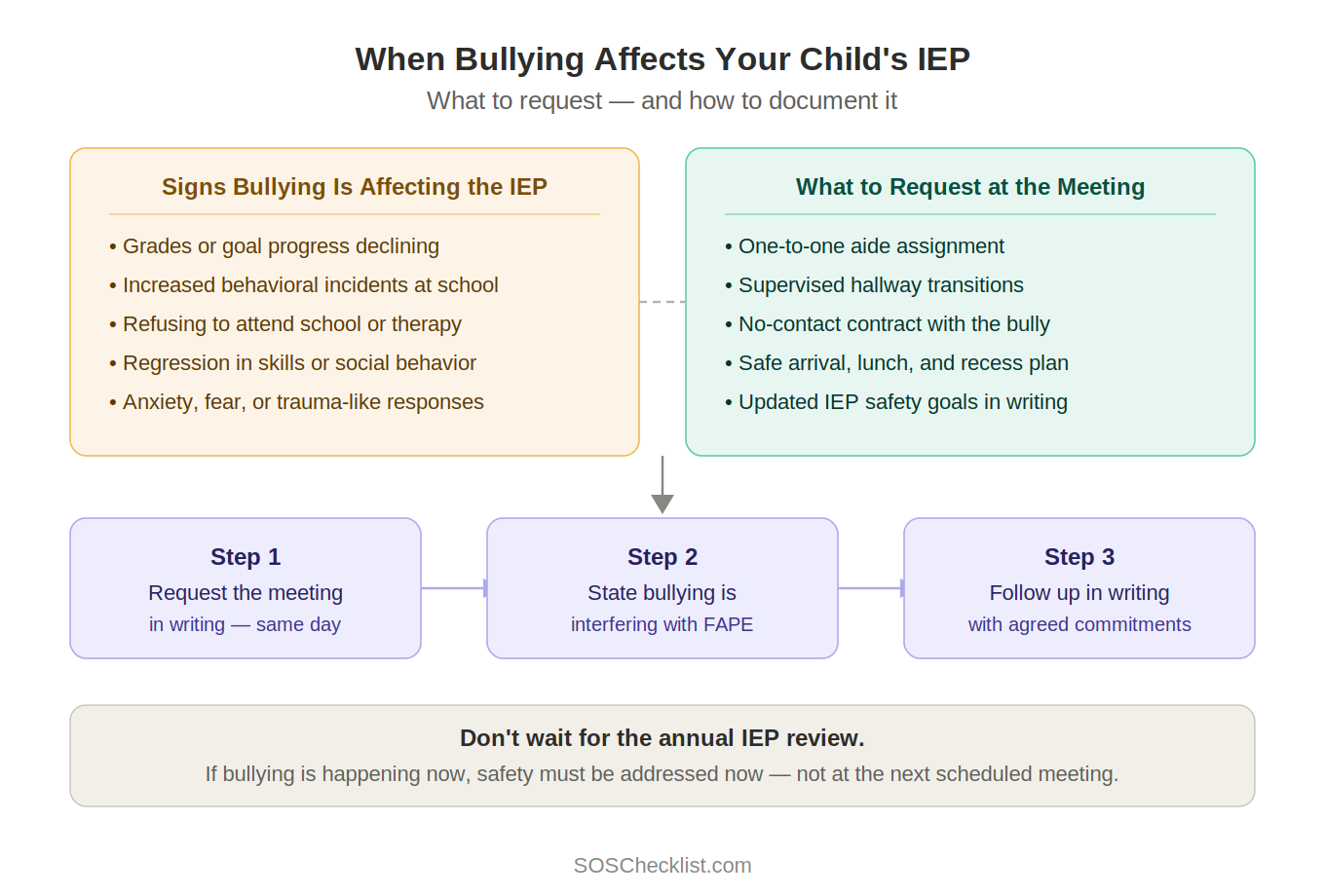
Not every bullying incident rises to the level of requiring an emergency IEP meeting. But several patterns are clear signals that the IEP process needs to be activated now:
Your child's academic progress has declined since the bullying began
Behavioral incidents at school have increased
Your child is refusing to attend school, therapy sessions, or related services
Your child is regressing in skills they had previously developed
You are seeing anxiety, fear, or trauma-like responses at home that are affecting daily functioning
Your child's IEP goals are becoming harder to reach because of the bullying environment
When you see these signs, the bullying is no longer a standalone concern — it is directly interfering with the purpose of the IEP itself.
When Bullying Affects Your Child's IEP — What to Request and How to Document It
How to Use the IEP as Your "Batman Cape"
I tell parents that the IEP is like a super cape — or a Batman cape, if you prefer. When it is used correctly, it gives you the ability to request maximum protections that other parents simply do not have access to.
At an emergency IEP meeting focused on safety, parents can and should request specific supports. These may include:
A one-to-one aide.
If your child is being targeted in unstructured settings — hallways, lunch, recess — an aide assigned specifically to your child creates a documented adult presence that changes the dynamic significantly.
Supervised hallway transitions.
I have seen parents successfully request that a teacher or staff member guarantee safe passage for their child during class transitions in high-risk areas of the building.
A no-contact contract.
This is a written agreement that the student who has been bullying your child will be kept away from them. It creates a documented commitment the school is on record as having made.
A structured safety plan for arrival, lunch, departure, and recess.
Unstructured times are where most bullying happens. A safety plan that addresses each of these moments specifically fills the gaps that a general bullying policy does not.
Updated IEP safety goals in writing.
Whatever is agreed upon at the meeting should be written into the IEP itself. Not summarized in meeting notes. Not promised verbally. Written into the document.
This is where I see parents lose ground — they leave the meeting feeling heard, but nothing was written down. Two weeks later, nothing has changed, and the school has no record of any commitment.
What to Document Before You Request the Meeting
Before you submit your written request for an emergency IEP meeting, organize what you already have. The stronger your documentation going in, the harder it is for the team to minimize or redirect the conversation.
What to gather:
A written record of bullying incidents — dates, what happened, who was involved, where it occurred
Any reports you have already made to school staff, and what response, if any, you received
Documentation of changes in your child's behavior, school performance, or emotional state since the bullying began
Any communications from the school about the bullying — even if those communications were vague or dismissive
A copy of your child's current IEP, with the goals that are being affected highlighted
When you walk into that meeting with a clear picture of how the bullying is interfering with your child's IEP goals, you are not just a concerned parent. You are a prepared advocate — and that changes the conversation.
Mistakes I Would Avoid
1. Waiting for the annual IEP review.
If bullying is actively affecting your child's safety and education, do not wait. Request the emergency meeting now.
2. Raising the bullying only verbally at the meeting.
Everything that matters must be in writing. Your request for the meeting should be in writing. Whatever is agreed upon at the meeting should be written into the IEP. A verbal promise from an IEP team member is not enforceable.
3. Treating bullying and the IEP as separate issues.
They are not separate when the bullying is interfering with your child's education. Frame it that way from the beginning — bullying is affecting FAPE, and you are requesting the IEP team address it.
4. Accepting a general response instead of specific commitments.
"We will look into it" is not a safety plan. "We will work on this" is not an IEP amendment. Push for specific, written, time-bound commitments before you leave the meeting.
5. Leaving without a written follow-up.
Even if the team writes things into the IEP at the meeting, send a follow-up email afterward confirming what was discussed, what was committed to, and when you expect to see it implemented.
6. Going into the meeting without organizing your documentation first.
A prepared parent is harder to dismiss. Bring a written summary of the incidents, the impact on your child, and the specific supports you are requesting. Do not rely on memory in the room.
Questions to Ask Before the Meeting
Has my child's IEP team been formally informed that bullying is occurring — in writing?
Can I clearly describe how the bullying is interfering with my child's IEP goals?
Do I have documentation of behavioral or academic changes since the bullying began?
Do I know specifically what safety supports I am going to request?
Am I prepared to ask that those supports be written into the IEP — not just noted in meeting minutes?
When Outside Help May Be Appropriate
IEP law is a specialized area, and navigating it while also managing a bullying situation can be genuinely overwhelming. If the IEP team is unresponsive, if previous meetings have produced promises but no follow-through, or if you believe your child's rights under federal law are being violated, consulting with a special education attorney or a qualified bullying/education advocate may be appropriate.
A school safety consultant can also help you organize your documentation and prepare for the IEP meeting — so you walk in knowing exactly what you have, what you need, and what you are going to ask for.
If your child is experiencing significant emotional distress as a result of the bullying, connecting with a qualified mental health professional who works with children is an important step that runs parallel to — not instead of — the IEP process.
Take the Safety Over Silence Checklist
Before your next IEP meeting or school communication, take the Safety Over Silence Checklist at https://soschecklist.net. It can help you identify what documentation you already have, what may be missing, and how prepared you are for the conversation ahead.
Disclaimer
The Student Readiness Checklist and Safety Over Silence content are educational resources only. They do not provide legal, medical, mental health, therapeutic, or crisis advice; determine whether a school or individual violated the law; guarantee a particular outcome; or create an attorney-client, therapist-client, or other licensed professional relationship. Laws, school policies, and procedures vary by jurisdiction and circumstance. Consult an appropriately qualified professional regarding your specific situation. If a child is in immediate danger, contact emergency services or the appropriate local authority. If a child is experiencing a mental health crisis or expressing thoughts of self-harm, call or text 988 in the United States or seek immediate qualified help.
Frequently Asked Questions
Can I demand an emergency IEP meeting specifically to address school safety?
Yes. Parents of children with IEPs can request an emergency meeting at any time — it does not need to wait for the annual review. The request should be submitted in writing and should clearly state that bullying is affecting your child's safety and ability to access their education.
When does bullying become an IEP-related issue?
When bullying begins to interfere with a child's ability to benefit from their IEP — through declining grades, increased behavioral incidents, school refusal, regression, or emotional distress — it is affecting the student's access to a Free and Appropriate Public Education, which is a federal right for students with disabilities.
What specific safety supports can I request at an IEP meeting?
Parents can request a one-to-one aide, supervised hallway transitions, a no-contact contract with the bullying student, a structured safety plan covering arrival, lunch, recess, and departure, and updated safety goals written into the IEP document itself.
What is FAPE and how does bullying affect it?
FAPE stands for Free and Appropriate Public Education — a standard established under federal special education law. When bullying disrupts a safe learning environment and interferes with a child's progress, it can become a FAPE concern. Consult a qualified special education attorney for guidance specific to your situation.
What mistakes do parents make when raising bullying at IEP meetings?
The most common mistakes are waiting for the annual review instead of requesting an emergency meeting, relying on verbal commitments instead of getting things written into the IEP, and treating bullying and the IEP as separate issues rather than connecting them to FAPE.
How can the Safety Over Silence Checklist help before an IEP meeting?
The Safety Over Silence Checklist at SOSChecklist.net helps parents organize warning signs, documentation, and communication history so they walk into the meeting prepared. Knowing what you have documented — and what gaps still exist — changes the quality of the conversation.
Is this article legal or special education law advice?
No. This article is educational content only. It does not constitute legal, special education law, medical, or mental health advice, and does not create any professional relationship. For guidance specific to your child's situation, consult a qualified special education attorney or other appropriate licensed professional.
When should I involve a special education attorney or advocate?
If the IEP team is unresponsive, if previous meetings produced commitments that were not followed through, or if you believe your child's federal education rights are being violated, consulting with a qualified special education attorney or education advocate is appropriate.
References
U.S. Department of Education — Individuals with Disabilities Education Act (IDEA): https://sites.ed.gov/idea/
U.S. Department of Education — Free Appropriate Public Education (FAPE): https://www2.ed.gov/about/offices/list/ocr/docs/edlite-FAPE504.html
StopBullying.gov — Bullying and Students with Disabilities: https://www.stopbullying.gov/bullying/special-populations/students-with-disabilities
U.S. Department of Education OCR — Disability Harassment: https://www2.ed.gov/about/offices/list/ocr/docs/disability.html
California Department of Education — Special Education Rights: https://www.cde.ca.gov/sp/se/as/ (URL should be verified before publication)