The Question Underneath the Question
When parents ask whether the school district can be held legally responsible, what they are usually really asking is this: does anyone in this system have to answer for what is happening to my child?
It is a fair question. And the answer, in many circumstances, is yes.
School districts can be held legally liable for failing to protect a student from bullying. Under federal law, schools have an obligation to provide what is called a Free and Appropriate Public Education — FAPE — which requires not just academic access but a safe learning environment. When a school fails to meet that standard and a student suffers as a result, accountability is possible.
But here is what I tell every parent who comes to me with this question: the difference between having a concern and having a case is documentation. And the difference between documentation and a frustrated parent venting in the principal's office is significant.
What I See Parents Doing That Weakens Their Position
I want to be direct about something I see happen regularly, because it matters.
When parents are scared and angry — and they have every right to be — they sometimes go into the school loud. They raise their voices. They threaten. They demand immediate action in a way that puts the school's attention on the parent's behavior rather than the child's safety.
Here is the problem with that: going into the school yelling gives the district an excuse to invoke what is called a civility code. And if the district invokes that code, they can restrict your access to campus — potentially placing a restraining order on you that prevents you from handling your child's business on school grounds.
You lose access. Your child loses their advocate on site. And the school has a documented reason to redirect the conversation away from the bullying and toward your conduct.
I am not saying your anger is not valid. It is. I am saying that how you channel it determines whether it helps your child or hurts your position.
Written documentation, calmly submitted, is far more powerful than volume.
What Makes a School District Accountable
School districts can be held accountable when bullying negatively impacts a student in four documented areas. Understanding these areas is the foundation of building a meaningful record.
What Documentation Builds School Accountability
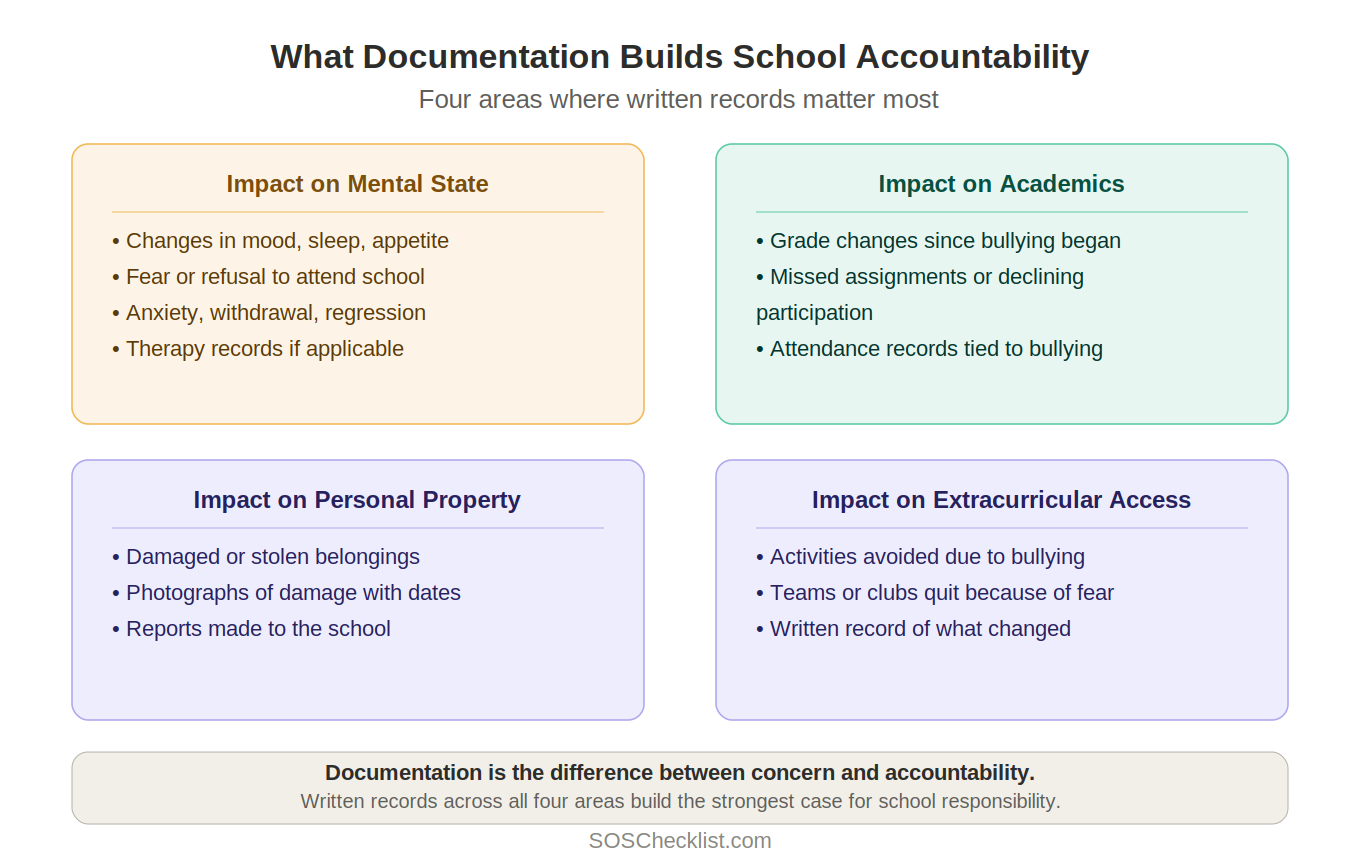
These four areas — mental state, academics, personal property, and extracurricular access — are the categories where the impact of bullying becomes documentable. When parents can show, in writing, that their child's wellbeing and educational access were harmed in one or more of these areas, and that the school was notified and failed to adequately respond, that is where accountability begins to take shape.
I want to be clear: this is not legal advice, and every situation is different. But understanding what matters in documentation helps parents focus their record-keeping on what counts.
What to Document and How
Mental state and emotional impact:
Document changes in your child's mood, sleep, appetite, and behavior since the bullying began. Keep a running written log with dates. If your child is in therapy, those records may be relevant. Note specific statements your child has made about fear, anxiety, or not wanting to return to school.
Academic impact:
Compare grades, assignment completion, and participation before and after the bullying started. Keep copies of any communications from teachers about declining performance. Document absences and whether they were connected to bullying-related fear.
Personal property:
Photograph any damaged or stolen belongings and note the date. Report each incident to the school in writing and keep a copy of every report.
Extracurricular access:
If your child has quit a team, dropped a club, or stopped participating in activities they previously enjoyed because of fear or harassment, document it. Write down what changed, when, and why.
Across all four areas, the principle is the same: write it down, date it, and keep a copy. A written record with dates is evidence. A memory is not.
Why Prior Notice Matters So Much
One of the most important elements of school accountability is what is called prior notice — establishing that the school was informed of the bullying before the harm escalated.
Prior notice does not require that you emailed the principal directly. It can be established by notifying any employee at the school site — a teacher, a counselor, even a janitor — because not all information flows directly to the principal. What matters is that a school employee was told, and when.
This is why I tell parents to document every conversation with any school staff member immediately after it happens. Use the speech-to-text function on your phone or a voice recorder while you are still walking out of the building, while the details are fresh. Then turn those notes into a written email summary you send to the relevant staff member that same day.
That email creates a timestamped record of notice. And that record matters enormously if the situation needs to be escalated.
Mistakes I Would Avoid
1. Going into the school angry instead of documented.
Yelling gives the district a reason to invoke a civility code and restrict your access (with a restraining order). Bring written documentation and a calm, specific request. That is what creates accountability.
2. Relying on verbal complaints instead of written reports.
A verbal complaint is not prior notice on paper. Everything important must be submitted in writing, with dates, names, and specific descriptions of what happened.
3. Documenting incidents without documenting impact.
The incident itself is one part of the record. The impact on your child — academic, emotional, social, extracurricular — is equally important. Document both.
4. Waiting until things are serious to start keeping records.
Documentation is most powerful when it shows a pattern over time. Start keeping written records from the first incident, not after things have escalated significantly.
5. Threatening a lawsuit before building a record.
I have seen parents threaten legal action in the first email, before they have any documentation. That approach often shuts down communication and puts the school on the defensive without giving you anything to stand on. Build your record first.
6. Assuming that because the school knows, they are on the hook.
Notice alone is not enough. The record needs to show that the school was notified, what the school did or failed to do in response, and what harm resulted. All three elements matter.
Questions to Ask as You Build Your Record
Do I have written documentation of every report I have made, including dates, recipients, and their responses?
Have I documented how the bullying has affected my child's mental state, academics, personal property, and extracurricular participation?
Can I show a timeline that connects the bullying to specific harms — grade changes, absences, behavioral shifts?
Have I established prior notice — written evidence that the school was informed?
Am I keeping my communications with the school calm, specific, and documented?
When Outside Help May Be Appropriate
If you believe a school district's failure to act has caused significant harm to your child — academically, emotionally, or physically — consulting with a qualified attorney familiar with education law or civil rights law in your state is an appropriate next step.
An attorney can evaluate your specific documentation and circumstances and advise you on whether and how to proceed. That is a conversation for a legal professional, not a blog post.
A school safety or bullying consultant can help you organize your documentation before that conversation — so that when you do speak with an attorney, you walk in with a clear, organized record rather than a pile of emails and a lot of anxiety.
If your child is experiencing significant emotional distress, connecting with a qualified mental health professional is also an important step that runs parallel to — not instead of — the documentation and advocacy process.
Take the Safety Over Silence Checklist
Before your next communication with the school or any professional, take the Safety Over Silence Checklist at SOSChecklist.net. It can help you identify what documentation you already have, what may be missing, and how to organize what you know before your next step.
Disclaimer
The Student Readiness Checklist and Safety Over Silence content are educational resources only. They do not provide legal, medical, mental health, therapeutic, or crisis advice; determine whether a school or individual violated the law; guarantee a particular outcome; or create an attorney-client, therapist-client, or other licensed professional relationship. Laws, school policies, and procedures vary by jurisdiction and circumstance. Consult an appropriately qualified professional regarding your specific situation. If a child is in immediate danger, contact emergency services or the appropriate local authority. If a child is experiencing a mental health crisis or expressing thoughts of self-harm, call or text 988 in the United States or seek immediate qualified help.
Frequently Asked Questions
Can a school district be held legally responsible for failing to stop bullying?
Yes, in many circumstances school districts can be held legally liable. Under the obligation to provide a Free and Appropriate Public Education, schools must ensure a safe learning environment. When a school is notified of bullying, fails to adequately respond, and a student suffers harm as a result, accountability may be possible. Consult a qualified attorney familiar with education law in your state for guidance specific to your situation.
What documentation do I need to hold a school accountable for bullying?
The most important documentation covers four areas: impact on your child's mental state, academic performance, personal property, and extracurricular access. You also need written records showing the school was notified — when, by whom, and what the school did or failed to do in response. Written records with dates are evidence. Verbal complaints are not.
What is a civility code and how can it affect my ability to advocate for my child?
A civility code is a school district policy that governs how parents and community members must conduct themselves when interacting with school staff. If a parent becomes confrontational or disruptive, a district can invoke this code and restrict their access to campus (with a restraining order). Going into the school angry or yelling can give the district a documented reason to limit your ability to be present for your child. This is why calm, written communication is always the stronger approach.
What is FAPE and how does it relate to bullying?
FAPE stands for Free and Appropriate Public Education — a standard under federal law that requires schools to provide students with a safe, accessible educational environment. When bullying interferes with a student's ability to benefit from their education, it may constitute a FAPE violation. Consult a qualified special education or education rights attorney for guidance on your specific situation.
How do I establish that the school had prior notice of the bullying?
Prior notice can be established by notifying any employee at the school site — not just the principal. A teacher, counselor, or any other staff member counts. The key is documenting those conversations in writing as soon as they happen — a follow-up email sent the same day creates a timestamped record of notice.
How can the Safety Over Silence Checklist help me build a stronger record?
The Safety Over Silence Checklist at SOSChecklist.net helps parents identify what they have documented, what may be missing, and where the gaps are in their record. Understanding your documentation gaps before you escalate or consult with a professional puts you in a significantly stronger position.
Is this article legal advice?
No. This article is educational content only. It does not constitute legal, medical, mental health, or crisis advice, and does not create any professional relationship. Laws, school policies, and procedures vary by jurisdiction. For guidance specific to your situation, consult a qualified attorney or other appropriate licensed professional.
When should I consult an attorney about school bullying?
If you believe a school district's failure to act has caused significant documented harm to your child — physically, academically, or emotionally — and the school has not responded adequately to written reports, consulting a qualified attorney familiar with education law or civil rights law in your state is appropriate. Organize your documentation before that consultation so you can present a clear, complete picture.
References
StopBullying.gov — Federal Laws: https://www.stopbullying.gov/resources/laws
U.S. Department of Education — Free Appropriate Public Education (FAPE): https://www2.ed.gov/about/offices/list/ocr/docs/edlite-FAPE504.html
U.S. Department of Education Office for Civil Rights — Harassment and Bullying: https://www2.ed.gov/about/offices/list/ocr/docs/dcl-factsheet-201410.pdf
California Department of Education — Bullying Prevention: https://www.cde.ca.gov/ls/ss/se/bullyingprev.asp
Oklahoma State Department of Education — Safe Schools: https://sde.ok.gov/safe-schools (URL should be verified before publication)